
Turkey Tail: What the Science Says
Trametes versicolor
Turkey Tail is the source of purified fractions PSK (Krestin) and PSP, which have been studied extensively — including as adjuncts in some oncology care systems outside the U.S.
What the research looks promising for
Published Asian trials of purified PSK alongside chemotherapy are among the strongest functional-mushroom clinical datasets; early U.S. work has examined immune-cell markers in survivors.
Where the evidence is thin — or cautionary
Evidence is strongest for purified PSK as an adjunct, not for whole-mushroom supplements as cures. Some popular claims rest on weak, non-controlled reports. Not HelloSpore product claims.
Watch & listen
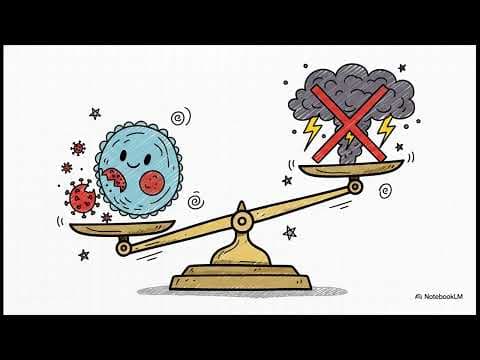
3 short, plain-language Turkey Tail resources built from the studies below.
The research (6 studies)
Sorted strongest-evidence-first. Each shows a plain-language bottom line and how much weight it can bear. See the plain-language glossary →
In the first human trial of Turkey Tail in breast-cancer survivors, daily doses were safe and boosted the immune cells that chemo and radiation often weaken.
Torkelson, C. J., Sweet, E., Martzen, M. R., Sasagawa, M., Wenner, C. A., Gay, J., Putiri, A., & Standish, L. J. (2012). Phase 1 clinical trial of Trametes versicolor in women with breast cancer. International Scholarly Research Notices Oncology, 2012, 251632.
Lab work found a way to package Turkey Tail's active compounds so they survive food processing and digestion — a step toward real products, tested only in cells so far.
Michalska, A., Szymanowska, U., Kapusta, I., Żurek, N., Nawrocka, A., Różyło, R., Jarocki, P., & Świeca, M. (2025). Antioxidant, anti-inflammatory, and antiproliferative properties of extracted Turkey tail (Trametes versicolor Lloyd) mushroom components microencapsulated with inulin. Food Chemistry, 495, 146348.
Lab and mouse work pinned down how Turkey Tail's approved cancer drug PSK switches on the immune system — answering a long-standing 'how does it work' question.
Lu, H., Yang, Y., Gad, E., Inatsuka, C., Wenner, C. A., Disis, M. L., & Standish, L. J. (2011). Polysaccharide Krestin is a novel TLR2 agonist that mediates inhibition of tumor growth via stimulation of CD8 T cells and NK cells. Clinical Cancer Research, 17(1), 67–76.
A safety/toxicology assessment of Lion's Mane and Turkey Tail powders found them generally well-tolerated at the doses tested — reassuring, though safety still depends on dose and product quality.
Mahadevan, K., Daoust, J., Brendler, T., Chaudhary, A., Saifi, A., & Garg, V. K. (2025). A toxicological assessment of Hericium erinaceus (Lion's mane) and Trametes versicolor (Turkey tail) mushroom powders. Frontiers in Toxicology, 7, 1651442.
A deep review of PSP, a Turkey Tail immune compound, and the several ways it appears to rev up the body's defenses against tumors.
Saleh, M. H., Rashedi, I., & Keating, A. (2017). Immunomodulatory properties of Coriolus versicolor: The role of polysaccharopeptide. Frontiers in Immunology, 8, 1087.
An early conference report suggested Turkey Tail supplements helped clear HPV infections — interesting, but unproven since it wasn't a controlled trial.
Couto, J. S., & Silva, D. P. (2008). Coriolus versicolor supplementation in HPV patients. Proceedings of the 20th European Congress of Obstetrics and Gynaecology.
Explore Turkey Tail spores & cultures
Laboratory-grade Trametes versicolor cultures for cultivation. Contaminant-free, discreet US shipping.
Shop the catalog →